Understand the Importance of the Buying Process

Getting the buying process right is about far more than generating leads
Businesses spend an enormous amount of time trying to get prospective customers through the door.
Marketing generates interest. Sales picks up the conversation. Eventually, somebody says yes.
But there are a lot of opportunities to lose them along the way.
Understanding the buying process means looking at everything that happens from the moment somebody realises they have a need, through to the point where they become a customer - and what happens afterwards.
For a low-cost purchase, that process might take minutes. In B2B, particularly where the investment is significant, it could take months and involve several people.
The principle is the same. At every stage, your potential customer is asking a slightly different question.
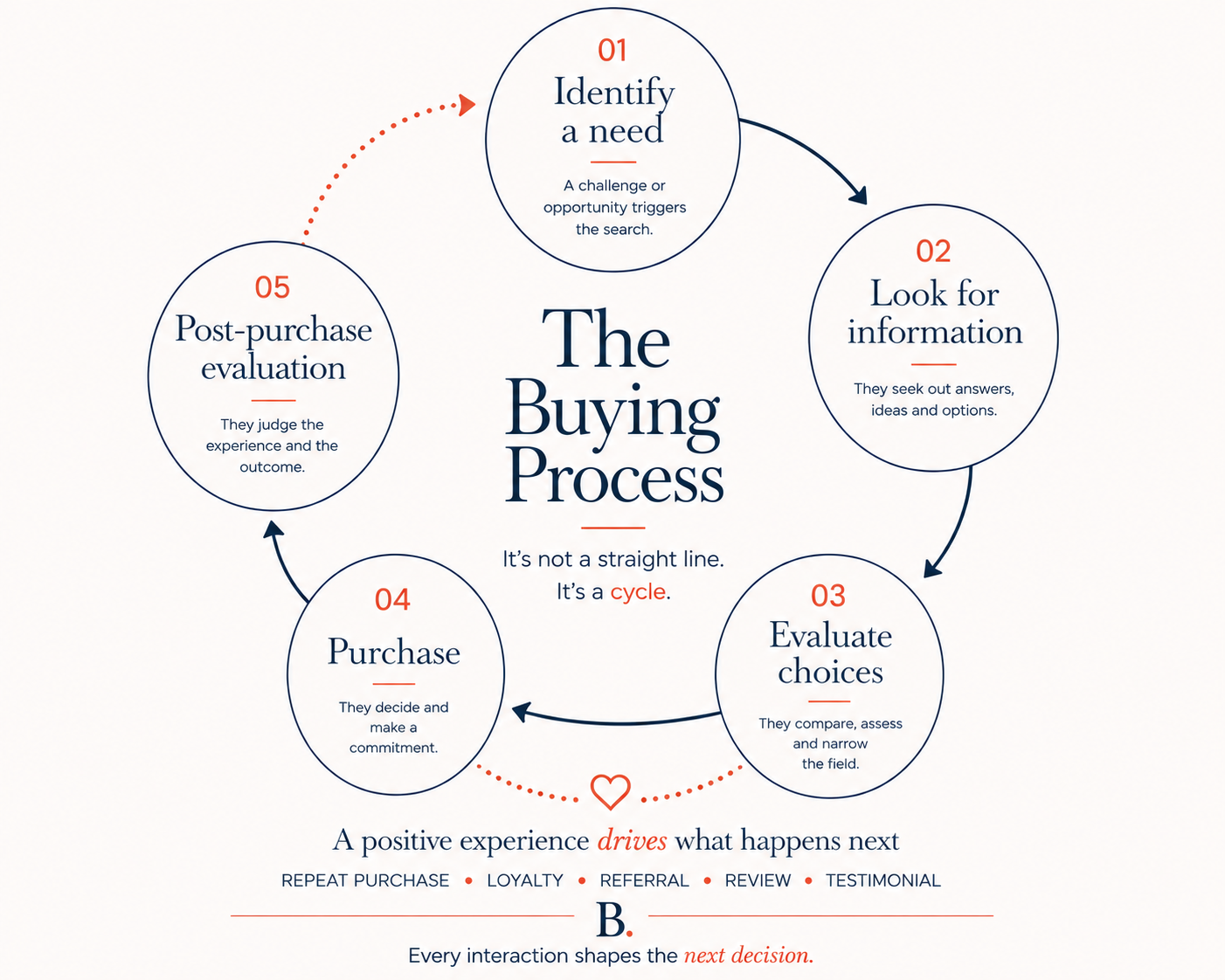
1. Identifying the need
Something has prompted the customer to think they need to make a change.
Perhaps something isn't working. A contract is coming to an end. Growth has stalled. They've spotted an opportunity. Or somebody around the board table has simply asked an uncomfortable question.
Marketing can create or reinforce that awareness, but don't assume the customer will immediately be ready to buy.
2. Looking for information
Now they're trying to understand the problem and their options.
They may search online, ask their network, look at LinkedIn, visit websites or speak to people they trust.
This is one reason I am wary of looking at marketing activity purely in terms of immediate ROI. Something you do today may influence a buying decision considerably further down the line.
Your job at this stage isn't necessarily to sell. It's to give them reasons to keep considering you.
3. Evaluating the choices
The shortlist gets smaller and the questions become more specific.
Can you do what they need? Do you understand their business? What evidence is there? Who else have you worked with? What will it cost? What are the risks?
For a significant B2B purchase, your buyer may also have to persuade other people internally.
Case studies, testimonials, credentials, conversations with your team and the quality of your proposal all help reduce the perceived risk of choosing you.
And this is where marketing and sales need to work together. The customer doesn't care which department owns which part of the process. They experience one business.
4. Making the decision
They've decided they want to buy. Don't make it difficult now.
This is where businesses can fall at the final hurdle - putting considerable effort into winning a customer and then introducing friction just as they are ready to say yes.
Complicated processes, delays, unclear terms, poor communication or a sudden change in the experience can introduce doubt at precisely the wrong moment.
The easier and more reassuring you make it to say yes, the better.
5. Reassuring them they made the right decision
The buying process doesn't end when the contract is signed or the money changes hands.
In fact, this can be one of the most important stages.
Your new customer has made a decision - and in B2B they may have put their own reputation behind it. They now want evidence that they made the right call.
Good onboarding, clear communication and delivering what you promised all reinforce that decision.
Get this right and you don't just have a sale. You have the foundations for retention, repeat business, referrals and advocacy.
Look at the whole journey
One of the problems I often see is that businesses examine these stages separately.
Marketing looks at leads. Sales looks at conversion. Operations looks at delivery. Customer service looks at what happens afterwards.
Your customer doesn't see those divisions.
They simply experience your business.
So rather than asking whether your marketing is working, it can be much more revealing to ask:
Where in our buying process are we making it harder for customers to choose us, buy from us or stay with us?
That's a rather different question - and sometimes it produces rather different answers.
If you'd value an experienced, independent perspective on what's happening across your marketing and buying process, let’s have a conversation.